Religious Heritage
FLETY
Eglise Saint-Léger à Fléty
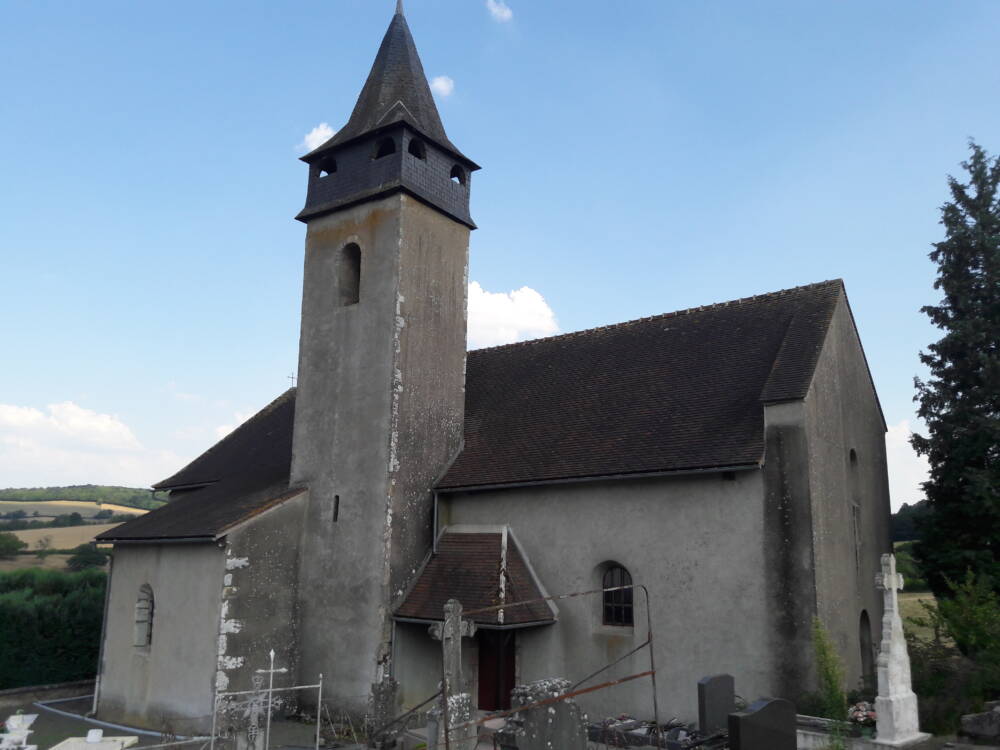
The date of construction of the Sainte-Madeleine church is unknown; however, the narrow and very abraded openings of the apse as well as the structure of the bell tower and the decorative repertoire of its capitals date these two parts back to the 1873th century. The structural work of the nave appears to date from the XNUMXth century. The whole was restored in XNUMX by Jean Chaillet, entrepreneur in Luzy.
In 1121, the bishop of Nevers, Fromond, gave the patronage of the cure to the canons of the Saint-Cyr church, patronage which they retained until the Revolution. In the XNUMXth century, the abbot of Cluny, who was lord of the bell tower, united the priory of Avrée with that of Saint-André-lès-Luzy. The priest as well as the owners of Fort-Lanty, Bussière and Chaumigny then shared the tithes.
In this very sober church, the most remarkable element is the elegant bell tower, listed in the supplementary inventory of Historic Monuments.
EXTERIOR DESCRIPTION
The bell tower, topped with a saddle (roof with two inclined slopes forming the sides of a building and placed between two gabled walls) is built on a square base. The elevation has only a small opening in the right wall. On the contrary, the bell chamber is open on its four sides by twin semi-circular bays, inscribed under an arch of the same nature. The capitals of the columns separating the bays are sculpted.
INTERIOR DESCRIPTION
The nave (the nave) is lit by five semi-circular windows, identical to those of the sacristy, and by a sixth (the last on the right) rectangular with interior embrasures in a segmental arch, identical to the right window of the choir.
The apse is pierced by two other much smaller bays, semi-circular and very abraded.
REMARKABLE ELEMENTS
The three doors (entrance and interior communication) are rectangular, but, on the sacristy side, the frame of the side door of the nave has rounded corners and chamfered edges with fillets (the edge is replaced by a curved surface ) decorated with geometric patterns.
A 16th century statue, in painted stone, represents Saint Joseph hugging the Child Jesus, contrary to the traditional iconography which shows him holding the child at arm's length, facing forward. In the 16th century, Saint Joseph no longer appears as a wise old man but as a father with his son.
Another statue, also from the 16th century, in polychrome stone, represents Saint-Antoine as a pilgrim, carrying a staff ending in a bell. At his feet stands a pig which is his privileged attribute.
ANECDOTES
About Saint-Antoine: the pig which is represented with him was originally a wild boar which he would have succeeded in taming and which would then have become a faithful companion. Saint Anthony was invoked against numerous human diseases (scabies, leprosy) and animal diseases, particularly against diseases of pigs and horses.
OPEN YOUR EYE!
A half-octagonal monolith font is set in the masonry near the entrance.
A small sink with a protruding polygonal shelf is located in the right wall of the nave.
For you to find them !
Visits
Individual visits
Free visits permanently.
Equipment
- Parking
Need inspiration?